
Why Curves Feel So Good in Interiors

Nature has been making a pretty convincing case for curves for millions of years, yet somewhere along the way we decided that our homes should consist largely of straight lines and right angles. Not that there’s anything wrong with a good right angle. I’m rather fond of them myself, particularly when it comes to architecture.
But put a beautifully curved chair against a straight wall, or an irregularly shaped coffee table in front of a very structured sofa, and the combination is immediately more interesting. It’s not necessarily the curve itself that makes the difference, but the contrast between the two.

Of course, interior design has now embraced curves with such enthusiasm that finding a piece of furniture with an actual corner is becoming something of a challenge. Sofas resemble oversized kidney beans, mirrors have developed wobbly edges, and now even kitchen islands need to be rounded off.

Some of it is fabulous, some of it feels rather forced, but our attraction to curved shapes is worth looking into. Particularly because there’s some interesting psychology behind it, and because nature was doing all of this rather successfully long before we started calling it a design trend.
Why We’re Drawn to Curved Shapes
There’s some interesting research into the way we respond to different shapes, and it turns out that our preference for curves may go beyond personal taste. Psychologists Moshe Bar and Maital Neta conducted a study into our preference for curved objects in which participants were shown objects with either curved or sharp contours. The curved versions were generally preferred, suggesting that the shape of an object can influence our reaction to it before we’ve even considered what it is.

Another study examining our responses to architectural interiors found that participants were more likely to judge curved interiors as beautiful than those with straight lines. Of course, these findings don’t mean everyone prefers curves, or that a rounded room is automatically more attractive, but they do suggest that our response to shape is rather more interesting than we might assume.
Our response to shape is rather more interesting than we might assume.

One possible explanation is that sharp angles can be associated with danger, while rounded shapes are perceived as less threatening. Which sounds rather dramatic when we’re talking about furniture, because I can’t say I’ve ever felt particularly intimidated by a rectangular dining table.
But if you think about how we respond to objects instinctively, it isn’t such a strange idea. A generously rounded armchair can look inviting before you’ve even sat in it, while a very angular chair might appear more formal or rigid. Whether either is actually comfortable is another matter entirely, and I have encountered enough beautiful but deeply uncomfortable furniture to know that appearances can be misleading.
I suspect our familiarity with curved shapes also has something to do with it. We encounter them constantly in nature, in the human body and in everyday objects, so perhaps there’s something reassuring about their familiarity. But I wouldn’t take that as an argument for replacing every straight line in your house.
Some of the most beautiful interiors I’ve seen are highly architectural, with strong geometry and very little softness in their shapes. A dramatic staircase, a perfectly proportioned rectangular doorway or a beautifully detailed piece of angular furniture can be every bit as appealing as something curved. Our preferences are influenced by much more than shape alone, which is fortunate, because otherwise interior design would be rather boring.

Taking a Few Design Lessons From Nature
There’s plenty of repetition, but very little is perfectly symmetrical.
Nature is particularly good at combining shapes that don’t necessarily follow any obvious rules. Look at a collection of stones on a beach, the branches of an old tree or the irregular outline of a coastline. There’s plenty of repetition, but very little is perfectly symmetrical, and even shapes that appear similar have their own variations.
We tend to associate these organic forms with nature, although the natural world also produces some wonderfully precise geometry. Honeycombs, crystals and the straight trunks of certain trees are good reminders that nature hasn’t completely abandoned the ruler.

What I find appealing about organic shapes in interiors is that they can introduce some of that irregularity without turning the house into a nature-themed decorating exercise. A coffee table inspired by the smooth outline of a river stone doesn’t need to resemble an actual boulder. A sculptural wooden chair can have the same flowing lines as a branch without looking like something you’ve dragged in from the garden.
Even a slightly asymmetrical ceramic vase can provide an interesting contrast to the straight edges of a shelf or cabinet. I particularly like these shapes when they’re made from materials that have their own natural variations, such as timber, stone or handmade ceramics.

There’s also quite a difference between a perfect circle and a more organic curve. A round dining table is still a very geometric piece of furniture, with a predictable shape and clear symmetry. An irregularly shaped table, on the other hand, introduces something less structured, particularly when the outline is deliberately uneven. Both can look beautiful, but they contribute something different to an interior.
I find the more organic shapes especially interesting in contemporary homes, where the architecture often consists of very clean lines and carefully measured proportions. The contrast can be subtle, but it gives the eye something different to look at.

And perhaps that’s part of why nature remains such a useful source of inspiration. Not because every interior needs to resemble a forest, beach or mountain landscape, but because natural forms offer an enormous variety of shapes, proportions and combinations. We can borrow a curved outline, an irregular edge or a particular silhouette without making the reference obvious.
In fact, I generally think the less literal interpretations are the more successful ones. There’s something rather satisfying about a piece of furniture that reminds you of something familiar without being able to put your finger on exactly what it is.

A Little Contrast Goes a Long Way
As much as I appreciate curved furniture, I think it often looks best when there’s plenty of straight geometry around it. A rounded sofa against a long, straight wall can look fabulous, particularly when paired with a rectangular rug or a more angular coffee table. The same applies to a circular mirror above a very structured console, a sculptural armchair positioned beside a traditional cabinet, or a curved bench against a bed.

The difference in shapes makes each piece more noticeable, rather than having everything compete for attention in the same way. I love mixing different materials and periods for much the same reason, and I think shapes deserve the same consideration.
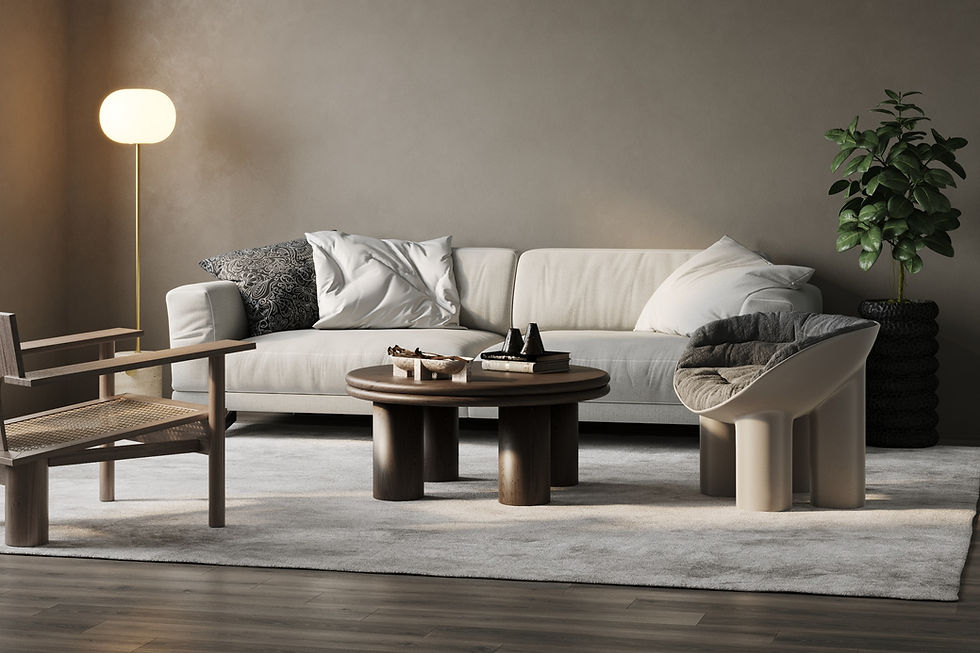
Imagine a contemporary living room with straight floorboards, large rectangular windows, a linear sofa and fairly simple cabinetry. Adding an irregularly shaped coffee table would break up the repetition without requiring you to change anything else.

You could achieve something similar with a curved floor lamp, a round side table or even a large sculptural vase. None of these needs to dominate the room, and that’s precisely why they can work so well. Sometimes, one unexpected shape is enough to make an arrangement more interesting.

The reverse can be equally effective. In a room with curved architectural features, such as arched doorways or rounded walls, I might deliberately introduce furniture with stronger, straighter lines. A rectangular dining table beneath a series of arches can look much more interesting than another rounded piece, particularly if the materials and proportions are carefully considered.
It’s tempting to repeat an architectural shape throughout the furniture, but doing so can make the whole arrangement feel a little too coordinated.

Scale also matters. A large curved sofa has a very different presence from a small round side table, and the amount of visual attention it attracts depends partly on what’s around it. If the sofa is already a substantial sculptural piece, adding an equally dramatic curved coffee table might be unnecessary.
A simpler, more angular table could allow the sofa to remain the main feature. There aren’t any fixed rules about how many curves a room should contain, but I do think it’s worth considering whether each one adds something or merely repeats what’s already there.

We’ve Been Here Before
For all the attention curved furniture is receiving at the moment, there’s nothing particularly new about our fascination with it. The Romans were building arches long before anyone thought of calling them an interior design feature, and curved forms have appeared in architecture and furniture throughout history.

Baroque interiors embraced elaborate, sweeping shapes, while Art Nouveau took inspiration from plants, flowers and flowing natural forms.
Art Deco introduced its own interpretation, with beautifully controlled curves, rounded corners and geometric arches. And then, of course, there was the furniture of the 1960s and 1970s, when designers seemed particularly enthusiastic about anything that didn’t resemble a conventional rectangle.
What I find interesting is how differently these periods approached the same basic idea. An Art Nouveau staircase with flowing wrought-iron details has very little in common with a chunky 1970s sofa, yet both rely on curves for much of their character. Art Deco curves often feel precise and architectural, while the organic furniture of the mid-century period can be far more sculptural and playful.

Today’s designs borrow from several of these influences, sometimes quite obviously. The rounded sofas, low-slung chairs and oversized sculptural tables we’re seeing everywhere would probably feel quite familiar to someone who spent the 1970s surrounded by similar furniture.

That doesn’t make them any less appealing, but it does put the current enthusiasm into perspective. Interior design has a habit of rediscovering things, giving them a new name and presenting them as though we’ve collectively invented something extraordinary.
Curves have survived countless changes in taste because they can be interpreted in so many different ways. A beautifully proportioned arch or a classic curved chair isn’t necessarily tied to one particular decade.
The more exaggerated interpretations, however, can become closely associated with the period in which they were fashionable, which is worth remembering when investing in a substantial piece of furniture.

When Everything Starts Looking Like a Kidney Bean
I have to admit that some of the current curved furniture is absolutely gorgeous. There are beautifully sculptural sofas, interesting organic tables and some fabulous chairs that look almost like pieces of art. I also love seeing curves incorporated into architecture, particularly when they’re part of the original design rather than added as an afterthought.
Even mirrors, which were doing perfectly well as circles and rectangles for centuries, now seem determined to resemble puddles.
But we’ve reached the stage where almost every furniture category seems to have developed a rounded version of itself. Even mirrors, which were doing perfectly well as circles and rectangles for centuries, now seem determined to resemble puddles.

The trouble with any popular design feature is that repetition eventually makes it less interesting. A single wavy mirror can be a fun addition to an interior, but when it’s accompanied by a scalloped cabinet, a curved sofa, a mushroom lamp and an irregularly shaped rug, the effect can become rather overwhelming.
Individually, each piece might be lovely. Together, they can start to look like someone has been shopping exclusively in the curved furniture department. I don’t think that makes curves a bad choice, but it does make me question whether every single one is there because it genuinely improves the design.

Curved architecture deserves particular consideration because it’s considerably more permanent than furniture. An original arch in an older building can be a wonderful feature, and a thoughtfully designed curved wall can be beautiful in a contemporary home.
But adding arches simply because they’re fashionable is another matter. A curved opening needs to make sense with the proportions and architectural style of the building, otherwise it can look rather out of place.
The same goes for rounded kitchen islands and curved cabinetry, which can involve additional expense and more complicated construction. If the result is something you genuinely love, that may be money well spent. If you’re doing it because every kitchen on Pinterest suddenly has rounded corners, I’d probably think twice.
Beautiful, But Is It Practical?
There’s also the question of how curved furniture actually works in everyday life. A round dining table, for example, can be wonderfully sociable because everyone faces one another and there are no awkward corners to navigate.

I’ve always liked that aspect of round tables, particularly for smaller gatherings where conversation is part of the pleasure of sitting down together. But they aren’t automatically the best choice for every dining room. A rectangular or oval table may accommodate more people within the available space, particularly in a long, narrow room. And once you start looking at very large round tables, reaching the middle can become quite an exercise.
Curved sofas come with their own considerations. They can look spectacular in a large living room, especially when there’s enough space to appreciate their shape from different angles.

In a smaller room, however, that same curve can make furniture placement more difficult. You may end up with awkward gaps behind the sofa or discover that the seating arrangement doesn’t work particularly well with the television, fireplace or other furniture.
A curved sofa isn’t necessarily less comfortable or less practical than a straight one, but its shape does need to suit the room rather than simply look beautiful in a photograph.
Its shape does need to suit the room rather than simply look beautiful in a photograph.
I think this is particularly important when considering expensive, permanent features. Rounded cabinetry, curved kitchen islands and bespoke architectural details can be stunning, but they also need to function properly. Storage can become more complicated, manufacturing costs may increase, and not every curved design makes efficient use of the available space.
That’s not a reason to avoid them, but I would want a good design justification beyond the fact that curves are currently fashionable. A beautiful shape is even better when it makes everyday life easier, or at least doesn’t make it unnecessarily complicated.

Curves Are Here to Stay, Just Not Necessarily These Curves
I don’t think our attraction to curved shapes is going anywhere, and history suggests it never really has. What will change is the way we use them. The oversized, rounded furniture we’re seeing everywhere today will eventually give way to something else, perhaps slimmer silhouettes, more restrained curves or another interpretation borrowed from an earlier design period.
Some of today’s pieces will become classics, while others will look unmistakably associated with the 2020s. That’s simply how design evolves, and I don’t think there’s anything wrong with enjoying a trend while it’s around.

For me, the most appealing interiors will always be the ones that combine different shapes rather than relying too heavily on one particular look. I love the precision of straight architectural lines, but I also appreciate what an unexpected curve can bring to a room.
An organic shape can introduce some irregularity, a rounded piece of furniture can provide contrast, and a beautifully designed arch can become an architectural feature worth celebrating. None of those requires every other object in the room to follow suit.

Nature certainly doesn’t limit itself to one shape, and I see no reason why our interiors should either. A combination of straight lines, gentle curves, irregular forms and the occasional sharp angle is far more interesting to me than an interior where everything has been rounded off for the sake of consistency. Besides, if we get rid of every corner, where exactly are we supposed to put the awkward furniture?


