
How To Turn Your Garden Into A Natural Extension Of Your Home

Most people don’t deliberately split their house and garden into two completely different worlds; it just happens over time. Inside gets all the attention, you tweak things, move things around, layer it properly, and then outside ends up being whatever fits. A table goes down, a couple of chairs, maybe some paving, and it’s technically “done”. It looks fine. It just doesn’t feel like it belongs to the same home.
The gardens that feel genuinely good to be in have a different quality. They feel connected. Not styled to death, not overly coordinated, just… consistent in a way you can’t quite put your finger on at first.

Start With What You Already Have
Before you start thinking about layouts or furniture, look inside your home properly. Not in a “what style is this” way, but in a very practical sense. What materials are actually there? What tones do you see all the time? Is it warm wood, softer neutrals, darker accents, brushed metals, or a mix of old and new?
Those choices don’t suddenly stop at your back door. If anything, they become more noticeable outside, because there’s less around them to soften the contrast. When the garden goes in a completely different direction, it immediately breaks that flow. When it follows on, even loosely, everything starts to feel more settled.

Let Materials Reappear
This is one of those things that sounds almost too simple, but it makes a huge difference. When a material or finish shows up more than once, it stops feeling random. A timber tone that comes back in outdoor furniture, a metal finish that isn’t a one-off, a colour that quietly links inside and outside.
It doesn’t need to be a perfect match, and in most cases, it shouldn’t be. Slight variation actually looks better. The point is that nothing feels isolated. Once you start noticing this in other homes, you can’t unsee it.
Slight variation actually looks better.

Think In Zones, Not In One Flat Space
A lot of gardens end up as one big open area with everything pushed against the edges. It’s practical, but it doesn’t do much for how the space feels. Even a small garden becomes more interesting when there’s a bit of variation in how it’s used.
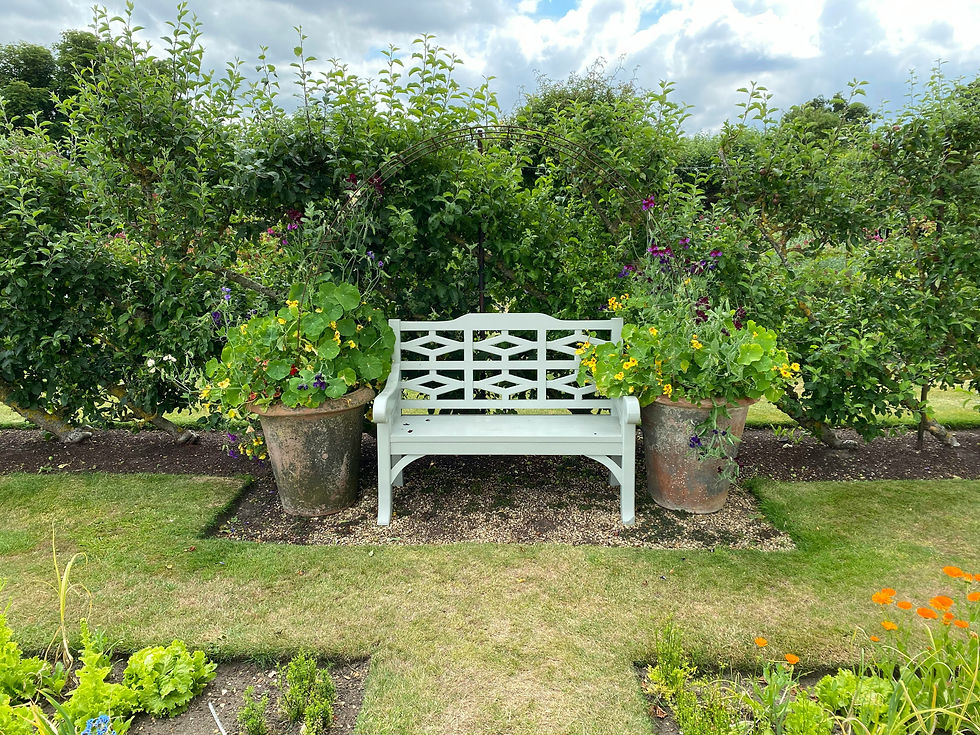
That might be as simple as a chair slightly tucked away from the main seating area, a small spot that’s just for plants, or a corner that catches the evening light. You’re not designing a park, you’re just giving the space a bit of rhythm so it doesn’t feel like everything is happening in one place.

Bring Some Softness Outside
Inside, you naturally build layers without thinking about it. Textiles, cushions, different textures, things that soften the harder elements. Outside, that often disappears and everything becomes stone, wood and metal.
Adding softness back in changes the feel straight away. Cushions that are actually comfortable, fabrics that move a little in the breeze, maybe even an outdoor rug to ground a seating area. It stops feeling like a setup and starts feeling like somewhere you’d stay for a while without thinking about it.

Don’t Fill Every Corner
Once you start improving a space, there’s a temptation to keep going: another plant, another chair, something on every surface. Everything looks good individually, so more must be better.

In reality, a bit of restraint makes everything else work harder. Leaving certain areas simpler gives your eye a break and makes the stronger elements stand out in a way that feels balanced rather than busy. It’s a small shift, but it changes how finished the space feels.
A bit of restraint makes everything else work harder.
Let It Feel Like One Story
The goal isn’t to make your garden look like your living room, and it’s definitely not about copying everything exactly. It’s about making sure nothing feels out of place. When materials relate, when the layout has a bit of thought behind it, and when there’s a balance between detail and space, the whole thing starts to make sense.

At that point, you stop thinking of it as “inside” and “outside”. It just feels like your home, with the doors open.


