
The 3 Things Your Eye Is Always Looking For In A Room

Have you ever walked into a room and instantly felt comfortable, even if it wasn’t quite your style? You might not have chosen the sofa. The colour palette may not have been yours. And yet the space felt settled. You didn’t feel the need to mentally rearrange it.
Then there are the other rooms. Perfectly nice furniture. Decent finishes. Nothing objectively wrong. But you feel slightly unsettled, as if something needs nudging. A lamp feels misplaced. A chair feels awkward. You can’t quite explain it, but the room feels unfinished. That reaction is not about taste. It is about how your eye reads space.

It is about how your eye reads space.
Whether you have studied design or simply rearrange your living room every six months, your eye is always scanning for three things: somewhere to land, some sense of order, and a feeling of balance.
When those are present, a room feels composed. When one is missing, the space feels restless, even if you cannot articulate why.
1. Your Eye Wants A Leader
When you enter a room, your brain instinctively looks for a focal point. It wants a starting point, something that quietly says, “Look here first.”
That might be a fireplace, a large piece of art, a strong headboard, a statement sofa, or even a beautifully framed window. Whatever it is, it anchors the room. It gives your eye direction.
Without a focal point, everything feels equal. And strangely, that is the problem. When nothing stands out, the eye keeps searching. The room feels vague.
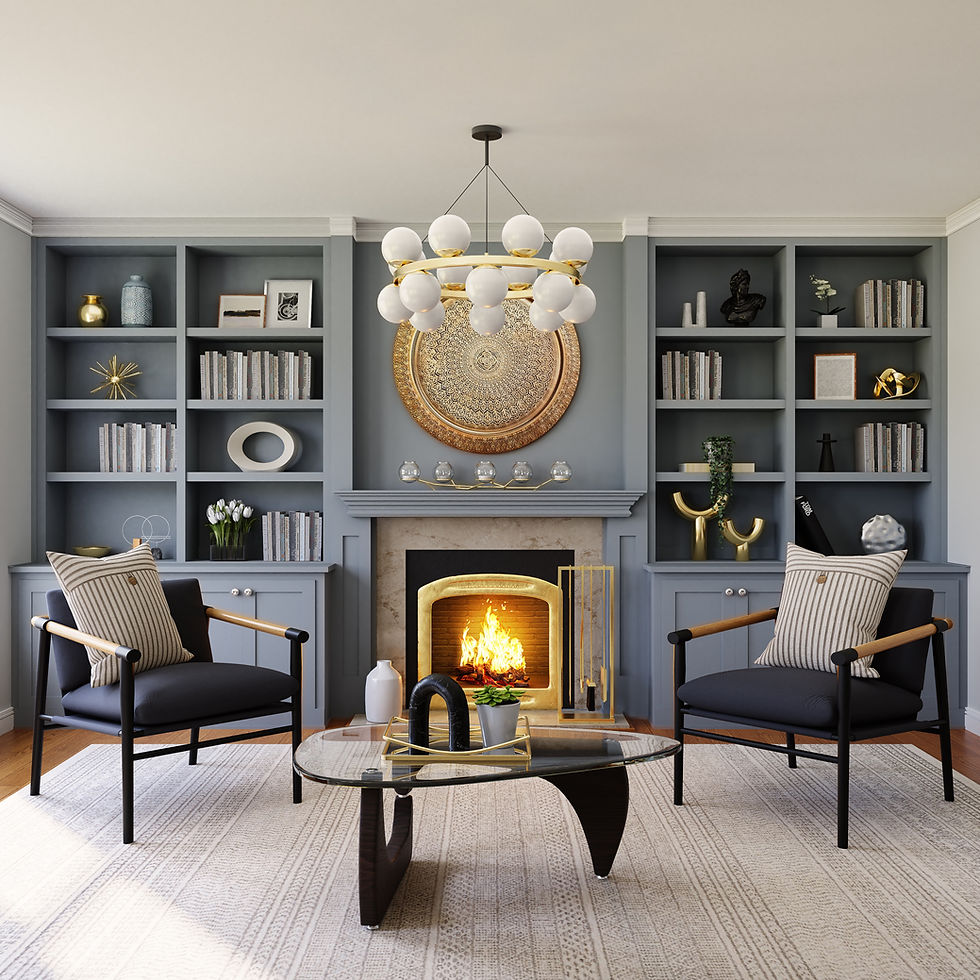
The opposite happens just as often. There are too many leaders. A bold wallpaper, a patterned rug, a dramatic light fitting, a gallery wall and a bright armchair, all competing for applause. Each one lovely. Together, slightly exhausting.
A strong interior is not about making everything impressive. It is about deciding what matters most and allowing the rest to support it. Once you notice this, you start to understand why some rooms feel confident and others feel uncertain.
2. Your Eye Wants Order
Humans are surprisingly comforted by repetition. We like logic in a room, even if we pretend we prefer spontaneity.
You may not consciously notice that the black in the window frames reappears in the light fittings, or that the warm timber of the floor is echoed in a coffee table. But your eye notices. It registers the repetition and relaxes.

When there is no repetition, a room can feel scattered. Brass here. Chrome there. A touch of matte black somewhere else. Three different wood tones that never quite speak to each other. Individually beautiful pieces that feel like they arrived separately and never formed a relationship.
Order does not mean everything matches. It means there is a thread. A colour that appears more than once. A material that is echoed. A shape that repeats subtly. This is what turns a collection of nice things into a cohesive scheme.
Designers are often accused of being overly particular about finishes and undertones. In reality, they are simply protecting that sense of visual logic.

3. Your Eye Wants Balance
Finally, your eye is constantly assessing visual weight. Some elements naturally feel heavier. Dark colours feel weightier than light ones. Large furniture pieces dominate more than delicate ones. Pattern pulls attention faster than plain surfaces. Even texture plays a role.
If too much weight sits on one side of a room, the space feels lopsided. A large dark cabinet on one wall with nothing to counter it. All the furniture pushed into a single corner. Or, conversely, everything floating awkwardly in the centre as though afraid of the walls.
Balance does not require strict symmetry. Some of the most interesting interiors are asymmetrical. What matters is that the weight feels intentional. When it is right, you rarely notice it. You simply feel that the room works.

A Small Shift That Changes How You See A Room
If you are not a designer, this may sound theoretical. In practice, it is surprisingly useful. When a room feels off, many people respond by adding something.
Another cushion. Another accessory. Perhaps a new side table. The assumption is that the space lacks personality. More often than not, it does not lack personality. It lacks clarity.
Instead of immediately buying something new, it can be helpful to pause and quietly run through three questions:
Where does my eye land first when I enter the room?
Is there repetition in colour, material or shape?
Does one side of the room feel visually heavier than the other?

These questions are not complicated, but they change the way you approach a space. Rather than decorating reactively, you begin adjusting with intention. You might reposition furniture to create a clearer anchor. You might remove one competing element instead of introducing another. You might repeat an existing material rather than adding a new one “for interest”.
Once you see it, you cannot unsee it.
Design theory does not need to feel academic. At its most useful, it simply explains something you already experience. Your eye has been doing this analysis all along. The difference is that now, you understand what it has been looking for. And once you see it, you cannot unsee it.


