
Why Beautiful Pieces Still Make Boring Rooms

There’s always that moment when you buy something for your home and you just know this is the one. This is what’s going to fix the room. The velvet chair will add depth, the lamp will make it feel warmer, the vintage rug will finally give it some character. You’ve already styled it in your head before it even arrives. It just makes sense.
And then you put it in place, take a step back… and nothing really changes. It looks nice, sure. But the room feels exactly the same. Not worse, not better. Just… another nice thing in the space.
Most people then think they picked the wrong item. So they try again. Something else. Maybe bigger, maybe bolder. Because clearly the room just needs more. It usually doesn’t.

The Problem Is Not Taste
Most homes are not filled with ugly things. They are filled with individually beautiful ones. The issue is rarely poor taste. It is disconnection.
We are very good at buying objects in isolation. Showrooms are designed to make each item shine independently. Social media presents furniture and lighting as sculptural statements against perfectly neutral backdrops. Everything looks convincing when it stands alone.

What you rarely see is what happens when all those pieces have to live together in one room. A space isn’t a collection of standout moments. It’s how everything relates to everything else.
If you’ve got a statement light, a bold rug, a standout chair and oversized artwork all trying to have their moment at the same time, it doesn’t feel exciting. It just feels a bit all over the place. Or oddly flat. Your eye doesn’t know where to land because everything is asking for attention at once.
But going the other way doesn’t fix it either. You pick calm, neutral pieces that all look “right” on their own. Nothing clashes, nothing feels risky, but the room still doesn’t come together. It ends up feeling a bit empty or unfinished because the materials don’t quite connect, the undertones are slightly off, and the proportions don’t fully work.
In both cases, the issue isn’t that the pieces aren’t nice. It’s that they’re not working together.
Design Is About Relationships, Not Objects
A good interior comes down to how things relate to each other. If you’ve got a warm timber floor that isn’t picked up anywhere else, it can feel a bit random. Same with a metal finish that shows up once and then disappears. Or a big sofa that visually dominates everything around it. You might not immediately know what’s off, but you can feel it.
These aren’t big, obvious mistakes. They’re small disconnects. But your eye picks up on them straight away.
Rooms that feel right tend to repeat themselves in a subtle way. A colour shows up again somewhere else. A material is echoed. The scale of pieces makes sense together. Nothing feels like it’s been dropped in as an afterthought.
That’s really the difference. Not budget, just intention.
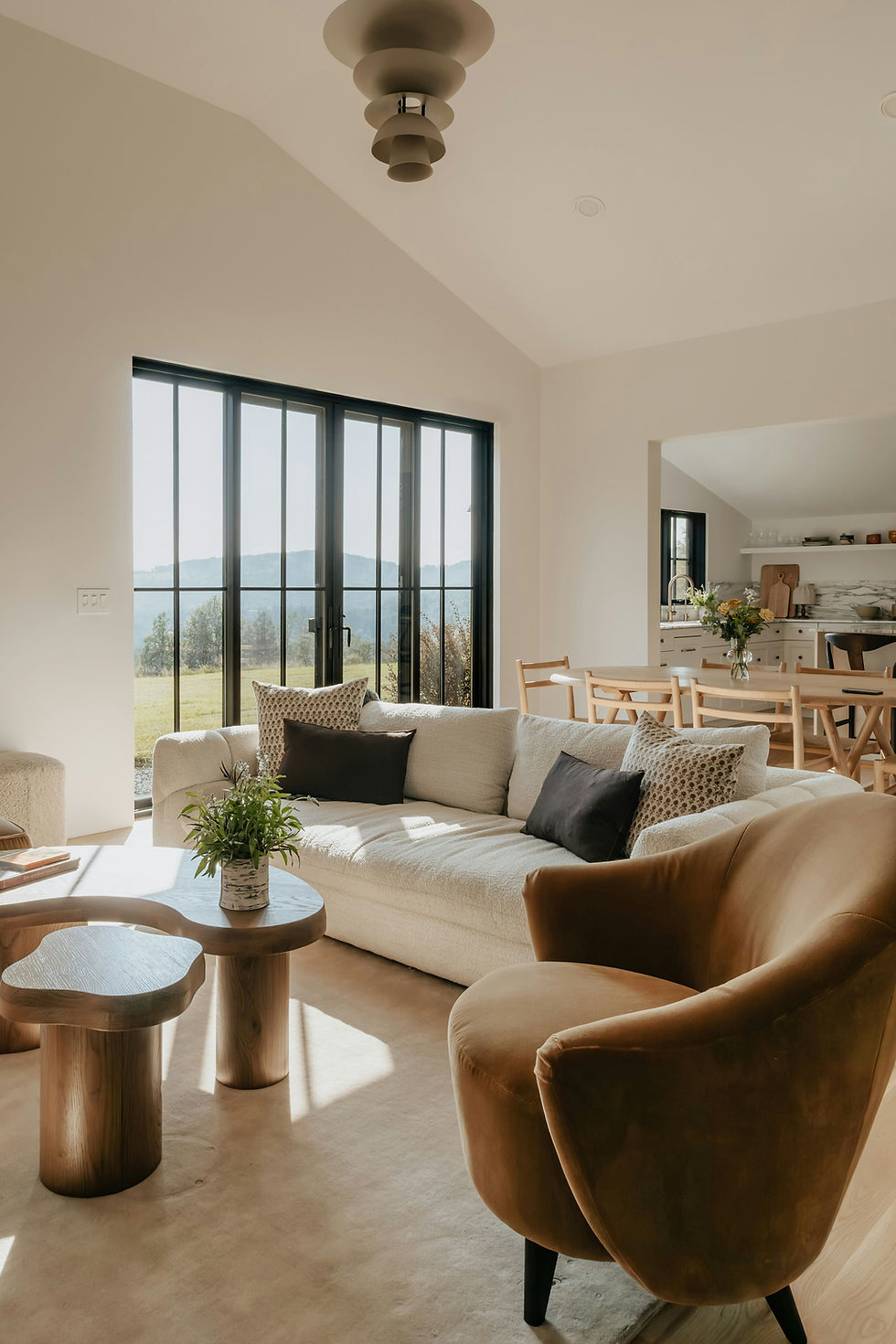
When Everything Is Special
There’s another trap people fall into. When everything in a room is “special”, nothing actually stands out.
If every piece is trying to be a moment, the whole idea of a statement just disappears. Your eye keeps jumping from one thing to the next and never really settles. It becomes tiring to look at, and oddly enough, less interesting.
And sometimes that’s why a room feels off. Not because it needs more, but because it needs less. Without a few quieter elements, the stronger pieces don’t get a chance to breathe.

Editing, although far less glamorous than shopping, is often the turning point. Removing competing element can be more powerful than adding a new one. Repeating an existing finish can be more effective than introducing something different “for variety.” This is the quiet discipline behind cohesive interiors.
Before You Buy One More Thing
When a room feels underwhelming, it is tempting to assume it needs more. In reality, it often needs clarity.
Instead of asking what you can add, it can be more revealing to ask:
Does this piece relate to what is already here?
Is there repetition of colour or material in the room?
Is one element visually dominating without support?
Would removing something strengthen the overall composition?

These questions aren’t there to limit you. They just help you see things more clearly. A collection of beautiful pieces doesn’t automatically make a beautiful room. It’s when everything starts to relate to each other, in material, scale and feeling, that a space really works.
Once you start looking at a room like that, as something where everything has to connect, your choices naturally become a bit more considered. Less impulse, more intention.
And maybe most importantly, you’ll pause before buying something. Not because it isn’t nice, but because you’re asking a better question: does it actually belong?


