
Things People Call ‘Timeless’ That Really Aren’t

‘Timeless’ gets thrown around a lot in interior design, usually when we’re trying to justify spending quite a lot of money on something. A timeless kitchen. A timeless bathroom. A timeless colour palette. Yet you can walk into plenty of supposedly timeless interiors and make a reasonably accurate guess at when they were renovated.
I don’t actually think there’s anything wrong with that. Houses are allowed to reflect the period they were designed in, and pretending otherwise can make us so cautious that we end up choosing everything based on what we think we won’t hate in twenty years rather than what we genuinely like now.

There are materials I would happily call timeless. Marble is one of them, and I’m prepared to defend that one. Timber, natural stone and properly laid parquet have been around for long enough to have earned the title too. But a timeless material doesn’t automatically make the way we’re using it timeless, and that’s where things get a little murkier.
The White Shaker Kitchen
The white Shaker kitchen may be the reigning champion of things described as timeless. The basic Shaker door has certainly been around for a very long time, but that doesn’t mean every kitchen using one somehow becomes immune to trends.
Put those doors together with a particular worktop, handles, splashback and flooring, and you can often narrow the installation date down surprisingly well. A kitchen can use traditional elements and still look very much like the decade in which it was designed.

I don’t think that makes Shaker cabinetry a bad choice at all. It’s simple, adaptable and works in an enormous range of houses, which probably explains why it keeps coming back.
But there’s a difference between something having longevity and being completely timeless. If you genuinely love a white Shaker kitchen, choose one because you want to live with it, not because somebody has promised you’ll never want to change it.
Greige, Because Apparently We Never Learn
Grey was timeless for a while. Then grey became the colour everyone desperately wanted to paint over, and warm beige, taupe and greige arrived to save us from it. These colours are now regularly described as timeless because they’re neutral, which conveniently ignores the fact that the previous generation of supposedly timeless neutrals was also neutral.

There’s nothing wrong with greige, and the right one can be a really beautiful background colour. But neutrals absolutely follow trends. Undertones change, the colours we pair them with change and even the amount of warmth we want from them changes. The current mushroomy, muddy neutrals will eventually tell us something about when a room was decorated, just as cool grey does now.
Black-Framed Shower Screens
A black-framed shower screen can still look fantastic, particularly in the right bathroom. But I’m not convinced by the idea that black automatically equals timeless because technically it isn’t a colour trend.
Put a black shower frame together with black taps, black handles and perhaps a black-framed mirror and you have a bathroom that is already fairly easy to place in design history.

This happens a lot with finishes that initially feel like a safe alternative to something more decorative. Once everyone starts using them, they become one of the easiest things to associate with a particular period. It doesn’t mean they suddenly look bad. It just means that neutral and timeless are not interchangeable words.
Reeded and Fluted Cabinetry
I love reeded cabinetry. I love the texture it brings, particularly when it’s done in timber, and I’d happily use it in the right interior. But it is absolutely a trend.
We’re seeing fluting and reeding on kitchen islands, bathroom vanities, sideboards, wall panelling and cabinetry, and whenever one detail starts appearing on everything from bespoke joinery to flat-pack furniture, I become fairly reluctant to call it timeless.

The material itself may age beautifully, especially if it’s solid timber, but the treatment will still tell part of the story of when it was designed. That doesn’t put me off using it. Not everything we love needs to qualify for some imaginary fifty-year design guarantee. Sometimes you can simply acknowledge that something is fashionable and still really like it.
Herringbone, With One Important Distinction
I love herringbone floors, and a proper timber herringbone or parquet floor is something I would absolutely put in the timeless category. There are centuries-old examples still looking beautiful, which feels like fairly solid evidence.
What I’m less convinced about is the idea that anything arranged in a herringbone pattern inherits that same status automatically. Herringbone-effect vinyl isn’t timeless simply because Versailles has parquet.

We’ve put the pattern onto ceramic tiles, vinyl planks, laminate, splashbacks, shower walls and patios, often in materials that have very little relationship with the original floors that made the pattern a classic.
Some of those applications will age better than others. The pattern has longevity, but context and material still matter enormously. A classic design can become very trend-led when we reproduce it in every possible surface.
Brushed Brass Everywhere
Brass itself has been used in interiors for centuries, so the material certainly isn’t new. The current version, however, tends to be a very specific brushed or satin brass, often repeated across taps, handles, lighting, shower fittings and furniture details. When every metal element in a room gets exactly the same fashionable finish, the result can become surprisingly easy to date.

I still prefer warm metals in plenty of interiors and wouldn’t avoid brass because it happens to be popular. I just don’t think calling every brushed-brass fitting timeless makes it so. The finish, shape and way it’s combined with everything else matter just as much as the metal underneath. The Victorians used brass too, but they weren’t installing the same tap you saved on Pinterest last week.
Handleless Kitchens
Handleless kitchens often get the timeless label because they’re simple. No decorative hardware, no fussy cabinetry and nothing obvious that should supposedly date. But minimalism has its own trends, and you can absolutely recognise kitchens from different periods by the way that minimalism was interpreted at the time.
High-gloss handleless kitchens already tell quite a specific story, while today’s matt versions in warm neutrals and timber will eventually do the same. Simplicity can certainly give a kitchen longevity, but it doesn’t remove it from design history altogether. ‘Clean’ and ‘timeless’ are two words that seem to get bundled together far too easily.

Arches
I like arches, so I’m certainly not waiting impatiently for them to disappear. They’re also a perfect example of why calling something either timeless or trendy can be far too simplistic.
Arches have existed in architecture for thousands of years, have fallen in and out of favour repeatedly, and are now very much back again. We’re putting them into doorways, niches, showers, cabinetry and sometimes places where there wasn’t remotely an architectural reason for an arch to begin with.
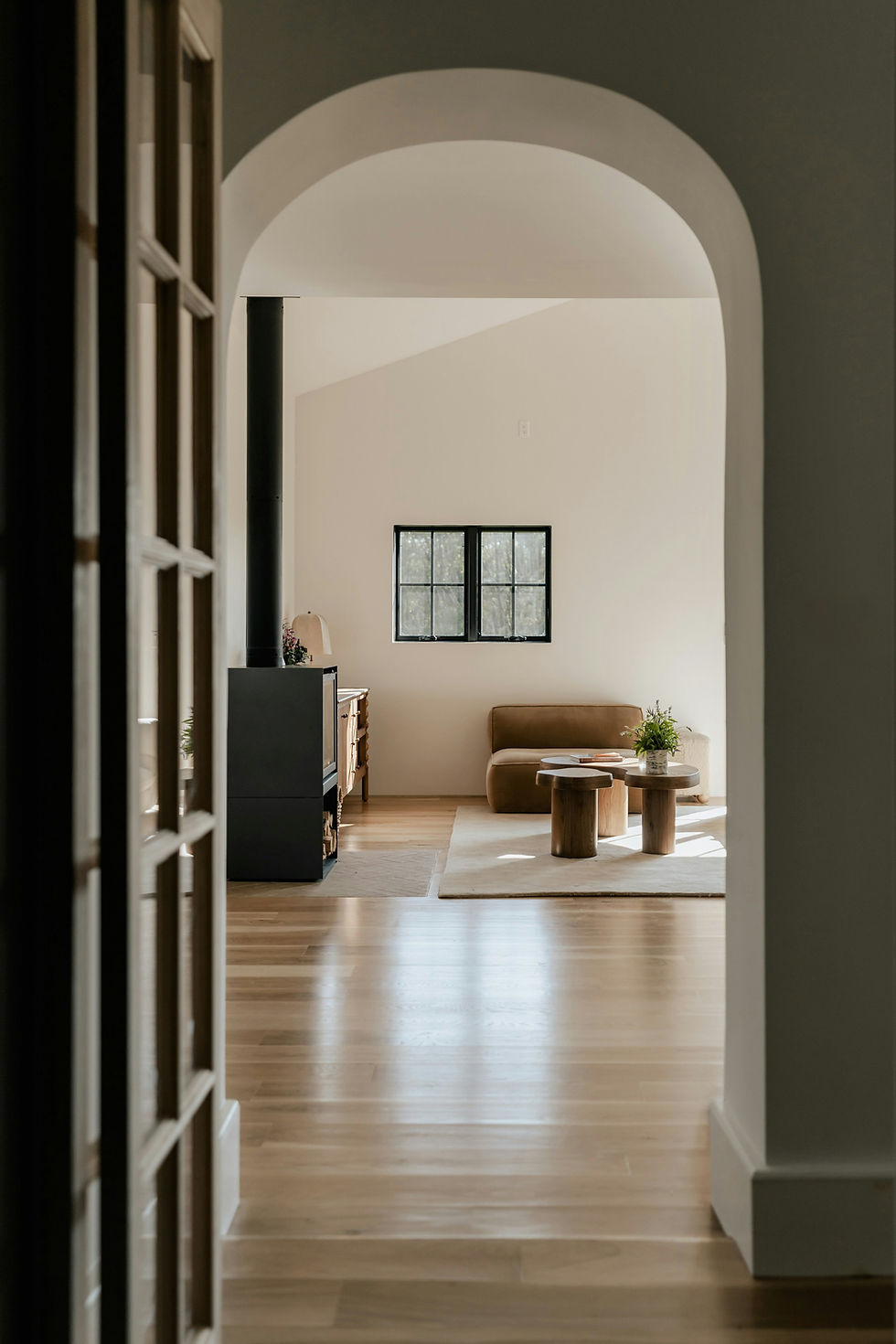
An original arched doorway in an older building can absolutely feel timeless. Adding three decorative arched niches to a newly renovated living room is much more connected to what we happen to like right now.
I still like them, and I may well continue liking them after the current trend passes. But their current popularity is also a useful reminder that trends don’t necessarily disappear forever. Quite often we just wait long enough and enthusiastically bring them back.
Slatted Timber Walls
Timber is timeless. A wall covered in narrow vertical timber battens is not automatically timeless by association. Slatted walls have become such a recognisable feature of contemporary interiors that they’re now available as ready-made acoustic panels you can attach to practically anything.
They can look great and bring warmth and texture to an otherwise plain room, but they are also very clearly having their moment.

This is one of the easiest traps with natural materials. We assume that because the underlying material has been used forever, the particular way we’re using it must be equally enduring. Timber can last generations while the treatment of it still dates. Those two things can quite happily be true at the same time.
Microcement
Microcement is another material that often gets described as timeless because it’s seamless, neutral and relatively understated. I’m less convinced. When the same finish starts appearing across floors, walls, bathrooms, kitchens and built-in furniture all at once, it’s usually a fairly good indication that we’re looking at a trend rather than something that has somehow escaped one.

I like microcement in the right setting, particularly when it suits the architecture rather than being added simply because it’s fashionable. But I suspect we’ll eventually be able to spot certain microcement-heavy interiors and immediately associate them with this period.
That doesn’t mean they’ll look terrible. Dating an interior and ruining an interior are not the same thing.
The ‘Quiet Luxury’ Interior
Cream upholstery, warm taupe walls, walnut, travertine, boucle, brushed brass and a very restrained amount of anything resembling colour. Individually, plenty of these materials and finishes have real longevity. Put every single one of them into the same room, however, and you’ve created a very specific look that belongs firmly to the current design landscape.

This is perhaps the biggest problem with trying to create a timeless interior by choosing only things currently described as timeless. If you select every supposedly safe material at exactly the same point in time, they date together.
The room becomes a snapshot of what we collectively considered sophisticated at that particular moment. Sometimes a few choices that don’t belong to the same trend cycle are exactly what stop an interior looking like it arrived as one complete package.
Some Things Really Are Timeless
I don’t think ‘timeless’ is completely meaningless. Marble has survived rather more design cycles than Instagram has, so I’m comfortable giving it the title. The same goes for beautiful timber, natural stone and genuine parquet.
Even then, the way we use those materials can still belong very clearly to a particular period. A huge waterfall island covered in heavily veined marble may eventually tell you roughly when the kitchen was designed, but that’s the application dating, not the marble itself.

Perhaps longevity is a more useful thing to aim for anyway. Choose good materials, get the proportions right and avoid making every decision around the same handful of trends.
More importantly, choose things you actually like enough to keep when everyone else has moved on to something different. Your kitchen doesn’t need to convince someone in 2046 that it was installed yesterday. If you still love living with it by then, I’d say it has done rather well.


